

Solitaire Terms Explained: A Complete Glossary for Every Player

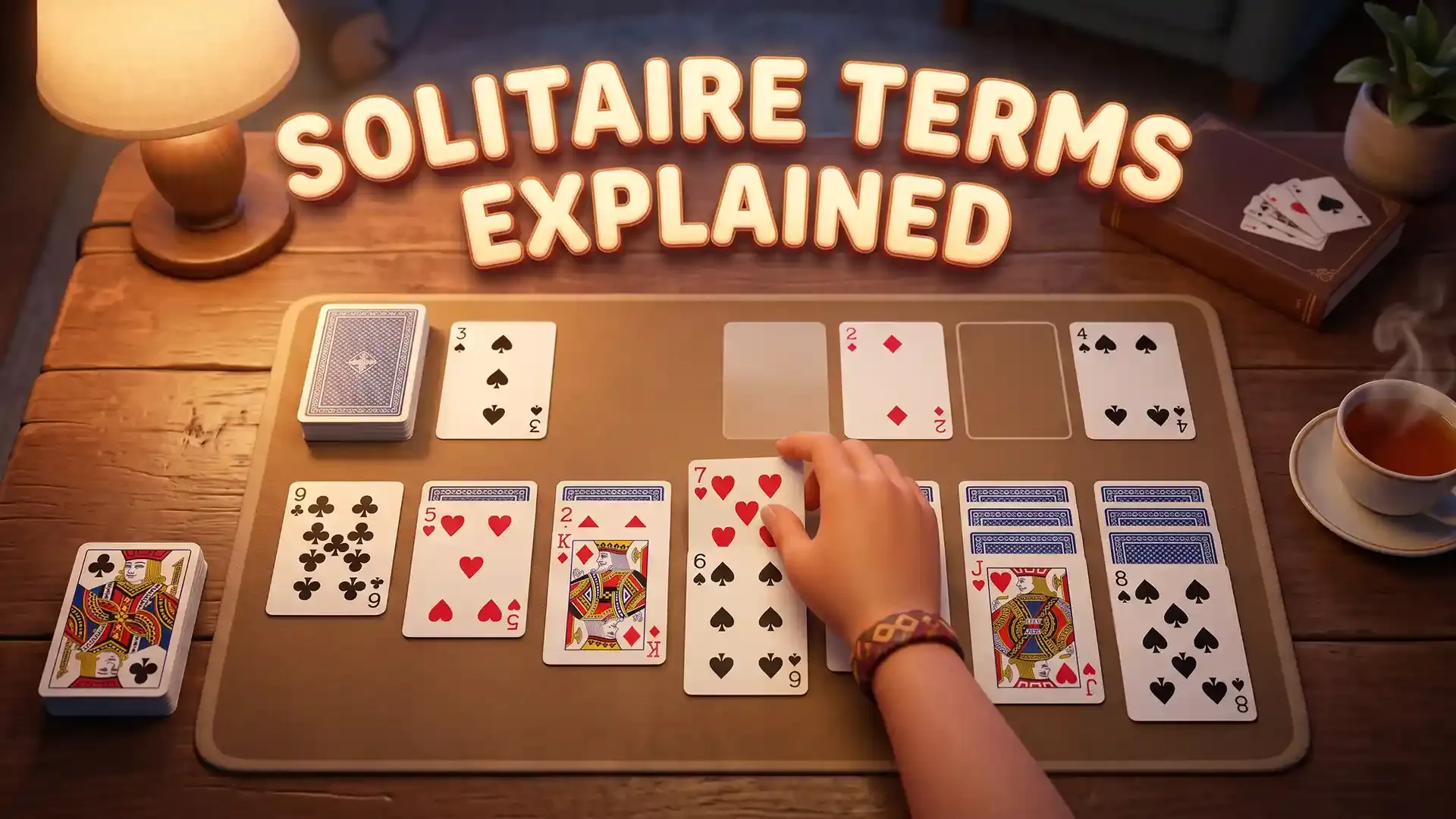
The process of learning any card game becomes intimidating when a barrage of jargon terms starts bombarding you from the outset. However, rest assured that mastering the layout of the board and movements of the cards is, by far, the most efficient way of improving your score.
This complete solitaire glossary breaks down every essential piece of vocabulary you need to master the game when you play solitaire online, from the layout of the board to advanced card movement techniques.
Table of contents
Quick-Reference Solitaire Terms Table
| Solitaire Term | Definition |
|---|---|
| Tableau | The main seven-column playing arena where you arrange your cards. |
| Foundation | The four target areas where you build suit sequences from Ace to King. |
| Stock | The face-down pile of extra cards used for drawing fresh options. |
| Waste Pile | The face-up pile that holds drawn cards that cannot yet be played. |
| Building | The process of stacking cards in the correct numerical order. |
| Expose | Revealing a face-down card by clearing the cards sitting on top of it. |
| Rank | The face value of a card spans from Ace to King. |
The Playing Area
The digital canvas or tabletop where you lay out your cards is divided into distinct zones. Each zone has its own set of rules regarding how cards can be placed or moved. Understanding these zones is one of the first things covered when learning how to play solitaire, since every move you make will involve at least one of these areas.
Tableau
The tableau is the main playing area of a solitaire game. In classic Klondike solitaire set up, it consists of seven columns of cards that make up the main body of the game. This is where most of your sorting and sequencing takes place.
Tableau Pile
Tableau Stacks are viewed as a single stack in Tableau. At the start of the game, the stacks are placed in a descending order from left to right, where the first stack will have only one card, while the second stack will contain two cards, and so forth. Knowing how to manage these stacks helps you excel at various games like solitaire that feature similar grid setups.
Foundation
This is where your cards will end up at last. In a game of solitaire, the primary goal that a player has to achieve is clearing his/her cards off the playing table by bringing all of them into this particular zone.
Foundation Pile
The foundation piles are separate cells within the foundation zone. The number of cells usually present in games such as solitaire is 4, reflecting the various suits on playing cards. Such piles should be organized by rank, from the Ace through the King.
Cells
These are empty spaces on the game board found in many solitaire games, including the game of FreeCell. They act as storage spaces for getting access to the piles on the bottom tableau piles. Learning how to navigate these open areas is essential when searching for the hardest solitaire game challenges on the web.
The Cards You Draw From
When you run out of moves on the main board, you must rely on the extra cards left over from the initial deal.
Stock (Stockpile)
The stock refers to the leftover cards that have not been dealt on the tableau during the initial dealing of the game. They are stacked upside down in the uppermost corner of the playing board, awaiting use in the game.
Waste Pile
Also known as the discard pile, the waste pile holds the cards that you have drawn from the stock but cannot immediately play onto the tableau or foundation. Cards in this pile sit face up, and only the topmost card is available for use.
Hand
In physical card games, the hand refers to the group of cards a player holds while drawing from the stock. In digital versions, it represents the specific batch of cards dealt from the stock to the waste pile during a single turn. If you want a smooth setup that functions like the best solitaire app on a mobile browser, look for layouts that make tapping this stack effortless.
Pass
A pass means going through the entire stock pile once. Some strict variations of the game limit you to a single pass, while more relaxed web versions allow unlimited passes through the deck to help you solve the puzzle.
Card Movement Terms
Mastering solitaire requires a solid grasp of how cards interact and change positions during gameplay.
Building
cis the action of arranging cards into a valid order on the board. You construct down in alternate colors on the primary tableau, whereas you construct up by building in the same suit on the foundation piles.
Sequence
A sequence refers to the continuous chain or series of cards in order. A sequence example could be a Red 7 on top of a Black 8, followed by a Red 6.
Expose
To expose a card entails turning face-down cards face up after eliminating all cards that lie on top of it. After exposure, the card is ready for use in the game. Advanced players who know how to play spider solitaire 4 suits match formats rely heavily on exposing hidden cards early to avoid getting stuck.
Play
Any play includes any move in the right direction towards accomplishing what the game requires. Moves could involve placing cards from the waste to the tableau, transferring sequences among columns, and exposing cards for the foundation. Learning the right moments to execute a shift is one of the most vital solitaire techniques for increasing your win rate.
Braiding (Laddering / Smoothing)
Braiding involves a sophisticated approach where one plans the tableau columns in such a manner that they alternate and repeat. In doing this, one makes it much easier to discover hidden cards, namely those that have been turned down.
Card Terminology
To understand the rules completely, you must know how individual cards are categorized and valued.
Rank
Rank refers to the numerical value or hierarchy of a card. In solitaire, the standard ranking order goes from Ace as the lowest value, through numbers two to ten, up to the Jack, Queen, and King as the highest values.
Suit
Suit represents one of the four iconic categories in a standard deck: Hearts, Diamonds, Clubs, or Spades. Keeping track of suits is critical because foundations require matching suits, while tableaus require alternating colors. Using ad-free websites is the best solitaire website to play online, allowing you for track these colors clearly without visual distractions.
Royalty (Court Cards)
Royalty, often called court cards, refers to the face cards in the deck: Kings, Queens, and Jacks. These cards hold unique strategic weight, as only Kings can be placed into empty tableau slots in standard Klondike.
Counterpart
A counterpart is a card that shares the exact same rank and color as another card, but belongs to the opposite matching suit. For instance, the Jack of Spades is the natural counterpart to the Jack of Clubs.
Deck
The deck is the complete set of playing cards used to run the game. Standard solitaire games utilize a single, traditional 52-card deck without any Jokers, making it an excellent option for anyone looking to enjoy classic card games to play by yourself.
Layout Terms
These terms describe how cards are positioned relative to one another within their respective columns.
Array
The array is the complete visual configuration of all the cards at any given point in the match. It encompasses everything visible on your screen, including the stock, the waste pile, the foundations, and the active tableau columns.
Top Card
The top card is the card situated at the very bottom of a cascading tableau column, or the highest visible card on the waste pile. Despite sitting visually lowest on a cascading column, it is technically the "top" card because it is completely unblocked and ready to be played. If you are aiming for a high score and want to discover professional solitaire strategies to keep your board moving, keeping an eye on these uncovered cards is the key to maintaining your momentum.
Bottom Card
The bottom card sits at the absolute rear or base of a tableau column. This card is usually a King or the very first card dealt into that specific column. It cannot be shifted unless the entire column above it is moved as a complete unit.
Conclusion
Learning basic terminology for playing solitaire games will enable you to become a master much more quickly than just playing the cards casually. This allows you to know the difference between Tableau and Foundation, as well as what can be done with the stock and waste.
In any case, whether you plan to attempt to conquer a challenging puzzle or just entertain yourself, by understanding the real language of the game, you will be guaranteed an effortless way of working around the rules while ensuring the best chance of success in your exploration history of solitaire.
FAQs
- The tableau is the main seven-column grid from which you perform most of your sorting operations. The objective in the tableau is to reveal any concealed cards and arrange them in decreasing order of their value in alternating colors until they can be transferred to the foundations.
- The stockpile lies face down and contains all the backup cards not distributed during the initial setup. The waste pile sits face up and holds the cards you have drawn from the stock pile but have not yet integrated into the main board.
- Building refers to arranging cards in accordance with the rules of the game being played. In the context of the tableau, building involves arranging cards vertically in alternating colors. On the foundations, building means stacking cards upward from Ace to King while matching the specific suit of the pile.
- The foundation consists of four designated slots located at the top of your layout. The game is successfully won when you manage to transfer all 52 cards from the playing area into these four slots, organized neatly by suit from Ace to King.
- A sequence refers to a set of cards laid out in numerical order consecutively. The requirement for such a sequence varies based on their position on the board. A good sequence could involve alternate cards of descending color or same suit cards in ascending order. It is useful in both serious and casual games.

Benefits of Solitaire: Boost Your Mind and Focus Today
Discover the benefits of Solitaire for brain health, focus, memory, and stress relief. Learn how this classic card game sharpens thinking and boosts mental clarity.

Is Every Solitaire Game Winnable? Discover the Truth Today
Uncover the history of Solitaire and trace its evolution from early card traditions to the iconic game enjoyed by millions today.
13 Types of Solitaire Games: The Ultimate Guide (With Rules, Variations & Tips)
Explore the different types of Solitaire games including Klondike, Spider, FreeCell, Pyramid, and more. Compare rules and find the version you enjoy most.

Word Hurdle Solitaire Game: Rules Explained
Word Hurdle Solitaire is an exciting card-based game that tests your word-building skills. This guide covers the complete rules, differences from other games, scoring system, and tips for beginners.
Spider Solitaire Rules: How to Play, Set Up & Win (Complete Guide)
How to play Spider Solitaire made easy—learn the rules, card setup, and proven strategies to improve your skills. Play smarter and win more games now!


