


Forty Thieves Solitaire Rules: Setup, Moves & Strategy

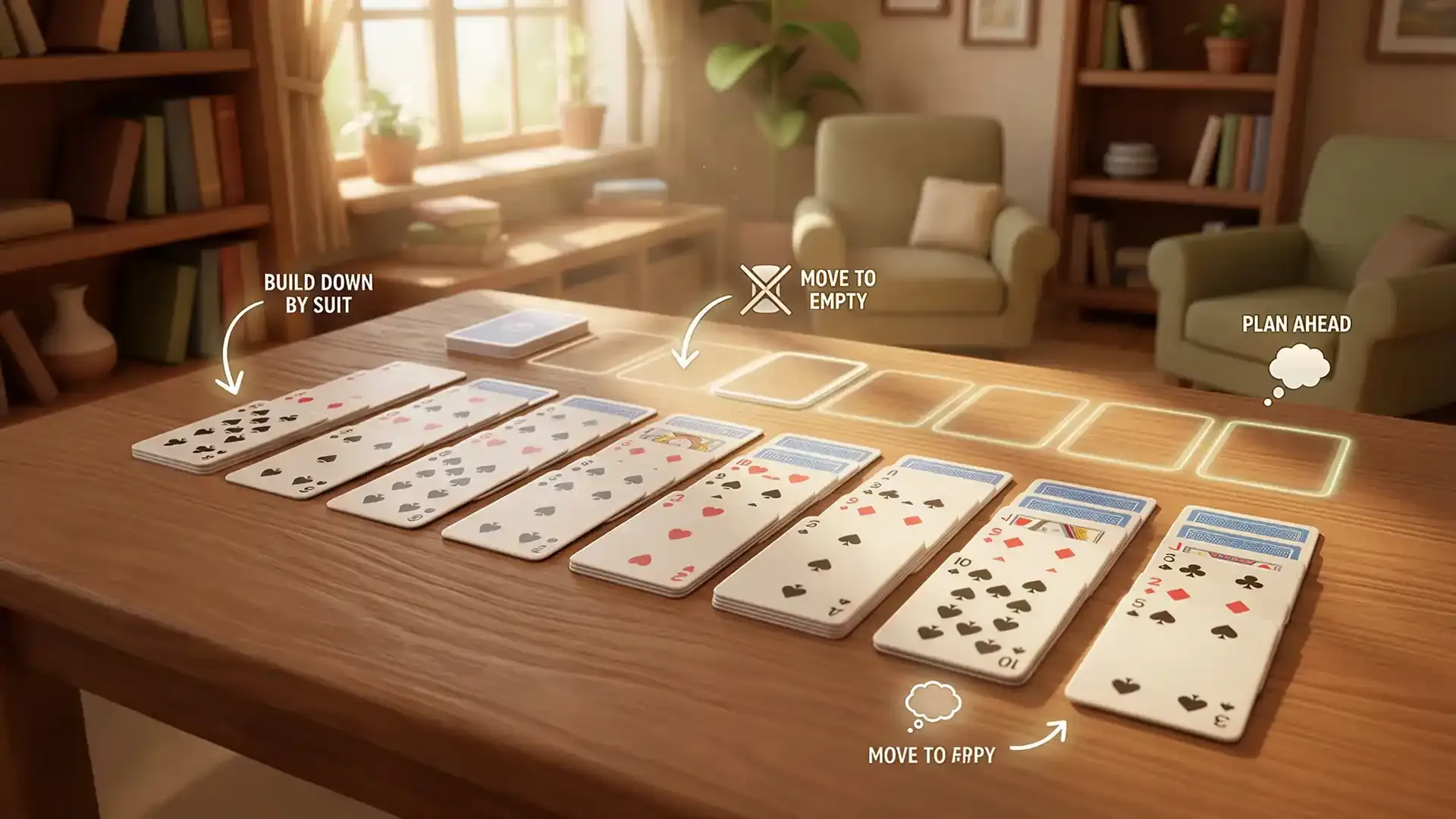
Forty Thieves Solitaire rules are a challenging card game in which one should think rather than act fast. There is no easy solitaire game like this, and every move matters every bit since a single miscalculation may ruin the whole game. Serious players are drawn to the game's difficulty and depth.
In the present day, the most popular choice of those willing to play solitaire online is to play it in a secure online environment, and you can also play Forty Thieves Solitaire online on most websites and play the game at any time, just like you would use real cards, gain a tactical advantage, and practice the game.
Table of contents
- What Is Forty Thieves Solitaire
- Why Forty Thieves Is So Challenging
- Objective of Forty Thieves Solitaire
- Forty Thieves Solitaire Setup Explained
- Forty Thieves Solitaire Rules Explained
- How to Play Forty Thieves Solitaire Step by Step
- Legal Moves in Forty Thieves Solitaire
- Common Mistakes Beginners Make
- How to Win Forty Thieves Solitaire Strategy Guide
- Is Forty Thieves Solitaire Always Winnable
- Forty Thieves Solitaire Variations
- Conclusion: Master Forty Thieves With Strategy
What Is Forty Thieves Solitaire
Forty Thieves solitaire is a solitaire that can be played using two decks and 104 cards. The game is also characterized as Napoleon at St. Helena and Big Forty. This is not a game that relies solely on luck like many other popular solitaire games.
You are presented with many cards, which you can see face up, but you are not free. As a result, thinking smart is more valuable than acting on the spot. Because of these limits, mastering effective solitaire strategies becomes far more important than acting quickly or relying on luck.
Why Forty Thieves Is So Challenging
The greatest challenge is creating rules. The cards in the tableau should be of the same suit, and the movement of a card can only be made one card at a time. It is impossible to fill in the blank spaces. A blocked card can be permanently blocked.
How It Differs From Klondike and FreeCell
In Klondike, one is allowed to alternate colors and the movement of card groups. FreeCell provides you with free cells to store cards. Forty Thieves does neither. It is more stern and punishes inconsiderate actions. That distinguishes the Klondike Solitaire Rules from the Forty Thieves.
Objective of Forty Thieves Solitaire
The goal is simple. Make eight piles of foundations Ace to King in one suit. Two decks are used; therefore, each suit is repeated twice. The winning game has all cards in the foundations by the rules.
Forty Thieves Solitaire Setup Explained
Understanding the setup is the first step to learning Forty Thieves Solitaire rules.
Cards Used
Two standard decks are used, making a total of 104 cards.
Tableau Layout
Forty cards are dealt face up into ten columns. Each column starts with four cards. These form the tableau where most gameplay happens.
Foundation Piles
Eight empty foundation piles are placed above the tableau. Each foundation builds upward from Ace to King in the same suit.
Stock and Waste Piles
The remaining cards form the stockpile. Cards are drawn one at a time and placed into the waste pile. The top waste card can be played.
Why Only Forty Cards Are Dealt to the Tableau
The limited number of starting cards increases difficulty. Many important cards remain hidden in the stockpile, often leaving players wondering how to win in solitaire-style games with limited information.
Forty Thieves Solitaire Rules Explained
These are the core rules you must follow to understand how many solitaire games are winnable when strict limitations are in place.
Tableau Building Rules
Cards are ranked from highest to lowest and must be of the same suit. For example, the six of hearts can be placed only on the seven of hearts. Only one card can be moved at a time.
Foundation Rules
Foundations start with Aces. Cards are added in ascending order and must match the suit. Once placed, a card cannot return to the tableau.
Stock and Waste Rules
Cards are drawn one at a time from the stock to the waste. Only the top waste card is playable. In most versions, you can go through the stock once.
One Card at a Time Movement Rule
You can never move groups of cards together. This rule is a major reason the game is difficult.
No Empty Column Filling Rule
If a tableau column becomes empty, it stays empty. You cannot place any card there.
How to Play Forty Thieves Solitaire Step by Step
This section breaks down the gameplay step by step and helps players understand how rule-based formats fit within different types of solitaire games.
Step 1: Scan the Tableau for Aces and Key Moves
At the start, look for Aces and low cards that can move to foundations without blocking others.
Step 2: Move Cards to Foundations Carefully
Move cards to foundations only when it helps free important cards. Do not rush.
Step 3: Build Tableau Columns Strategically
Try to uncover lower cards, especially twos and threes. These control the pace of the game.
Step 4: Draw From the Stock When Needed
Use the stock only when no good tableau move exists. Each draw matters.
Step 5: Alternate Between Stock and Tableau Moves
Switch between areas to keep options open. Avoid locking cards under higher ranks.
Step 6: Complete All Eight Foundations
Continue careful play until all cards are moved to the foundations.
Legal Moves in Forty Thieves Solitaire
Knowing legal moves prevents costly errors.
What Moves Are Allowed
You can move one card at a time within the tableau if suit and rank rules are met. You can move cards from the tableau or waste to the foundations.
What Moves Are Restricted
You cannot move card groups. You cannot place cards into empty columns.
Legal Tableau Moves
Descending order and same suit only.
Legal Foundation Moves
Ascending order and same suit starting with Ace.
Legal Stock and Waste Moves
Draw one card and play only the top waste card.
Common Mistakes Beginners Make
Many players lose because of small mistakes. Moving cards to foundations too early can block important tableau plays. Blocking low rank cards like twos and threes slows progress. Ignoring buried cards leads to dead ends.
How to Win Forty Thieves Solitaire Strategy Guide
This section focuses on how to win Forty Thieves Solitaire more often.
Prioritize Freeing Buried Cards: Always aim to uncover hidden low cards. They unlock many future moves.
Delay Foundation Moves When Needed: Keeping cards in the tableau can sometimes create better building options.
Track Card Locations Mentally: Remember where key cards are located, especially Aces and twos.
Avoid Unnecessary Stock Draws: Each draw reduces flexibility. Use the stock with purpose.
Is Forty Thieves Solitaire Always Winnable
No. Even expert players face unwinnable deals. The estimated win rate is around eleven percent. Skill improves your chances, but luck still plays a role. Some deals block essential cards too deeply.
Forty Thieves Solitaire Variations
Several variations soften or change the difficulty. It is similar to Spider Solitaire in terms of difficulty.
Diplomat Solitaire
Allows moving card groups, which increases win chances.
Josephine Solitaire
Josephine Solitaire lets you move a group of cards at once, which makes things easier, but it's not in the classic Forty Thieves Solitaire game.
Forty and Eight Solitaire
Uses similar rules with slight setup changes.
Congress and Parliament
More complex versions with extra tableau columns.
Conclusion: Master Forty Thieves With Strategy
Forty Thieves Solitaire rewards patience and planning. Learn the rules well and respect the strict movement limits. Focus on freeing key cards and think several moves ahead. With practice, you will improve your success rate and enjoy the challenge this classic game offers.
FAQs
- Use two decks. Build a tableau downward by suit. Build foundations upward by suit. Move only one card at a time. Do not fill empty columns.
- Forty Thieves Solitaire have Strict rules, limited movement, and low win rates make it one of the toughest solitaire games.
- No, you can’t move groups of cards in Forty Thieves Solitaire, as only single-card moves are allowed in the standard version.

Benefits of Solitaire: Boost Your Mind and Focus Today
Discover the benefits of Solitaire for brain health, focus, memory, and stress relief. Learn how this classic card game sharpens thinking and boosts mental clarity.

Is Every Solitaire Game Winnable? Discover the Truth Today
Uncover the history of Solitaire and trace its evolution from early card traditions to the iconic game enjoyed by millions today.
13 Types of Solitaire Games: The Ultimate Guide (With Rules, Variations & Tips)
Explore the different types of Solitaire games including Klondike, Spider, FreeCell, Pyramid, and more. Compare rules and find the version you enjoy most.

Word Hurdle Solitaire Game: Rules Explained
Word Hurdle Solitaire is an exciting card-based game that tests your word-building skills. This guide covers the complete rules, differences from other games, scoring system, and tips for beginners.
Spider Solitaire Rules: How to Play, Set Up & Win (Complete Guide)
How to play Spider Solitaire made easy—learn the rules, card setup, and proven strategies to improve your skills. Play smarter and win more games now!


