

Word Hurdle Solitaire Game: Rules Explained


Playing Word Hurdle solitaire is an exciting game, and knowing the rules and game-winning strategy is quite easy to understand; also, it makes your mind a bit more off than the other solitaire games.
If you are still confused about how to play Word Hurdle, this guide will walk go through it step by step and help you understand the rules, tips, and winning strategies.
If you are already amazing with vocabulary and puzzles, then it will be easier for you to win the game, as you will remember the words, but you still need daily practice for that.
This daily puzzle keeps your mind sharp as you are expected to guess a secret word by making a series of strategic guesses. Whether new to word puzzles or long experienced, mastery unfolds through understanding Word Hurdle’s mechanics.
Success follows those who learn its patterns slowly. A steady approach replaces guesswork over time. Through repetition, clarity emerges without force. The method becomes clear only through consistent practice. Progress depends less on instinct and more on observation.
Table of contents
What is Word Hurdle, and what are the basic rules of the game?
Beginning with intuition often leads to landing on the correct term through careful spelling in Word Hurdle. Success shows itself when few attempts are needed to uncover the answer. Frequently chosen, this pastime draws both young and older players without distinction.
The idea behind this is pretty basic: you put in a word, and the game gives you feedback with color-coded tiles. You then eliminate possibilities based on that feedback, testing your deductive skills in linguistics. Much like a solid solitaire strategy, success depends on your ability to analyze the board and think several steps ahead to find the best move.
Word Hurdle Rules: How the Game Works
To succeed, you must first master the fundamental word hurdle rules. The game is governed by a strict feedback loop that tells you exactly how close your guess is to the target word.
The Color Clue System Explained
The most important part of the word hurdle game rules is the color-coded feedback system. After every guess, the tiles will change color:
- Green: The letter is in the word and it is in the right place.
- Yellow: The letter is in the word, but it is in the wrong place.
- Gray: The letter is not even present in the word.
The only way to solve the puzzle is to use these colored clues. GREEN is called the lock, YELLOW is a hint, and GRAY is elimination.
The Solitaire Twist (playsolitaire.game Version)
On online solitaire websites such as playsolitaire.game, the experience is enhanced by a stylish card-themed UI. Though the underlying algorithm is no different from before, the UI here is focused more on speed and seamless gameplay, with no distractions. The focus here is on simplicity and ease-of-use, where the game helps you keep track of all the letters you have used via the virtual keyboard. Check out our Word Hurdle series now!
How to Play Word Hurdle: Step by Step
These are the numbered steps that will guide you through your first attempt at solving the game:
- Enter your first word: Input your first word that has a minimum number of letters as required by the game.
- Analyze color clues: Evaluate the letters in the box that become green, yellow, or gray.
- Adjust your next guess: Generate your next word with the same green letters in place while moving the yellow letters.
- Narrow down letters: Remove common letters with each new try. Just like following solitaire rules to clear the board, this step-by-step logic helps you reveal the hidden solution.
- Solve within attempts: Solve the puzzle either by finding the right word or losing all your attempts (usually 6 attempts).
Worked Example: A Sample Game Explained
Imagine the target word is SHARK.
- Guess 1: PLATE — The 'A' turns yellow, all other letters are gray.
- Guess 2: ROAST — The 'R', 'A', and 'S' turn yellow.
- Guess 3: SHARK — All tiles turn green! Success.
Tips and Strategies to Win Word Hurdle
Strategies of Word Hurdle solitaire are important, and the most important step is the first one. In order to be the most efficient, use words with heavy vowels or words with high-frequency consonants (R, S, T, L, N).
- Ideal starts: ARISE, NOTES, or AUDIO.
- Goal: Narrow down which vowels are present as early as possible.
How to Read Color Clues Strategically
Don't just look at individual letters; focus on patterns. If you have a yellow 'H' and a green 'S' at the start, your mind should immediately look for common pairings like 'SH' or 'CH'. Most importantly, avoid repeating gray letters; it is a wasted turn that provides zero new information.
Mid-Game Strategy
By the third or fourth guess, you should switch to the elimination method. If you are stuck between two possible words, try a word that uses the remaining “unknown" letters to see which ones light up. This is often better than "guessing and hoping" with your final attempts.
Card-Specific Tips (playsolitaire.game)
On our platform, use the visual keyboard to your advantage. It highlights the letters you’ve already ruled out, allowing you to focus entirely on the remaining alphabet. This minimalist design helps you avoid "brain fog" during the final, tense guesses.
Word Hurdle Variations: 4, 5, and 6 Letter Modes
Word Hurdle stands out by offering different difficulty levels based on word length:
- 4-Letter Mode: Great for beginners or quick warm-ups.
- 5-Letter Mode: The standard classic difficulty.
- 6-Letter Mode: For advanced players.
A single added letter greatly increases the number of possible word arrangements; therefore, stricter methods are necessary. Though small in size, its impact on structure grows rapidly. With more options emerging, control must tighten accordingly. Complexity rises without warning when one character changes everything. Precision matters more once variety expands beyond simple forms.
FAQs
- Each round offers six attempts to uncover hidden terms within a grid. After every try, feedback appears in green, yellow, or gray, indicating letter placement accuracy. Guessing continues under these fixed conditions until completion. Clues adjust subtly based on prior inputs. The structure remains unchanged throughout gameplay. Success depends solely on interpreting positional signals over time.
- By default, Word Hurdle allows six guesses before the player fails to find the right answer. Other formats or larger grids can provide additional tries, but six is still the official competitive number of tries in the daily challenge.
- Should a tile become green, the letter fits exactly where placed. Where letters appear in yellow, they belong somewhere else within the word. Grey indicates that a particular character does not feature at all. Visual feedback guides choices without revealing answers outright.
- Identical at first glance, the two share core mechanics yet separate through subtle shifts in word length options and layout controls. Enthusiasts often tackle each version side by side, drawn not by novelty but routine. Victory odds shift slightly when both are played, one after the other, morning habits unfolding without fanfare.

Benefits of Solitaire: Boost Your Mind and Focus Today
Discover the benefits of Solitaire for brain health, focus, memory, and stress relief. Learn how this classic card game sharpens thinking and boosts mental clarity.

Is Every Solitaire Game Winnable? Discover the Truth Today
Uncover the history of Solitaire and trace its evolution from early card traditions to the iconic game enjoyed by millions today.
13 Types of Solitaire Games: The Ultimate Guide (With Rules, Variations & Tips)
Explore the different types of Solitaire games including Klondike, Spider, FreeCell, Pyramid, and more. Compare rules and find the version you enjoy most.
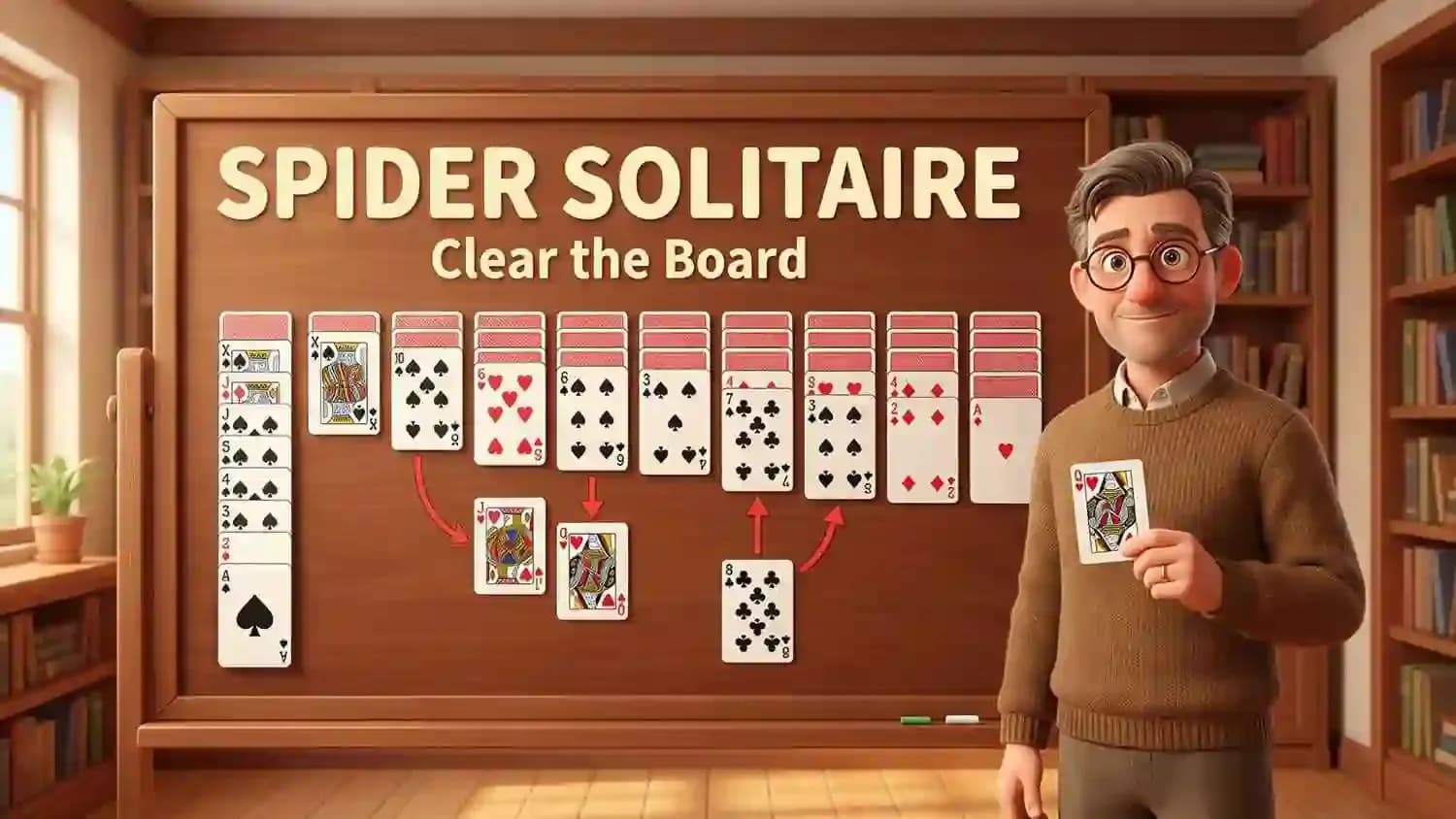
Spider Solitaire Rules: How to Play, Set Up & Win (Complete Guide)
How to play Spider Solitaire made easy—learn the rules, card setup, and proven strategies to improve your skills. Play smarter and win more games now!
How to Play Klondike Solitaire: Rules, Setup, Tips, and Strategy
If you own a computer, you already know Klondike Solitaire — it’s the world’s most recognized card puzzle game. It was originally designed as a hidden game in Windows to teach users how to use a mouse, and millions fell in love. If you’ve just developed an interest in the game or want to learn winning strategies and expert tips, you’re in the right place.


