


How to Play Solitaire: Rules, Moves & Winning Tips (Beginner Guide)

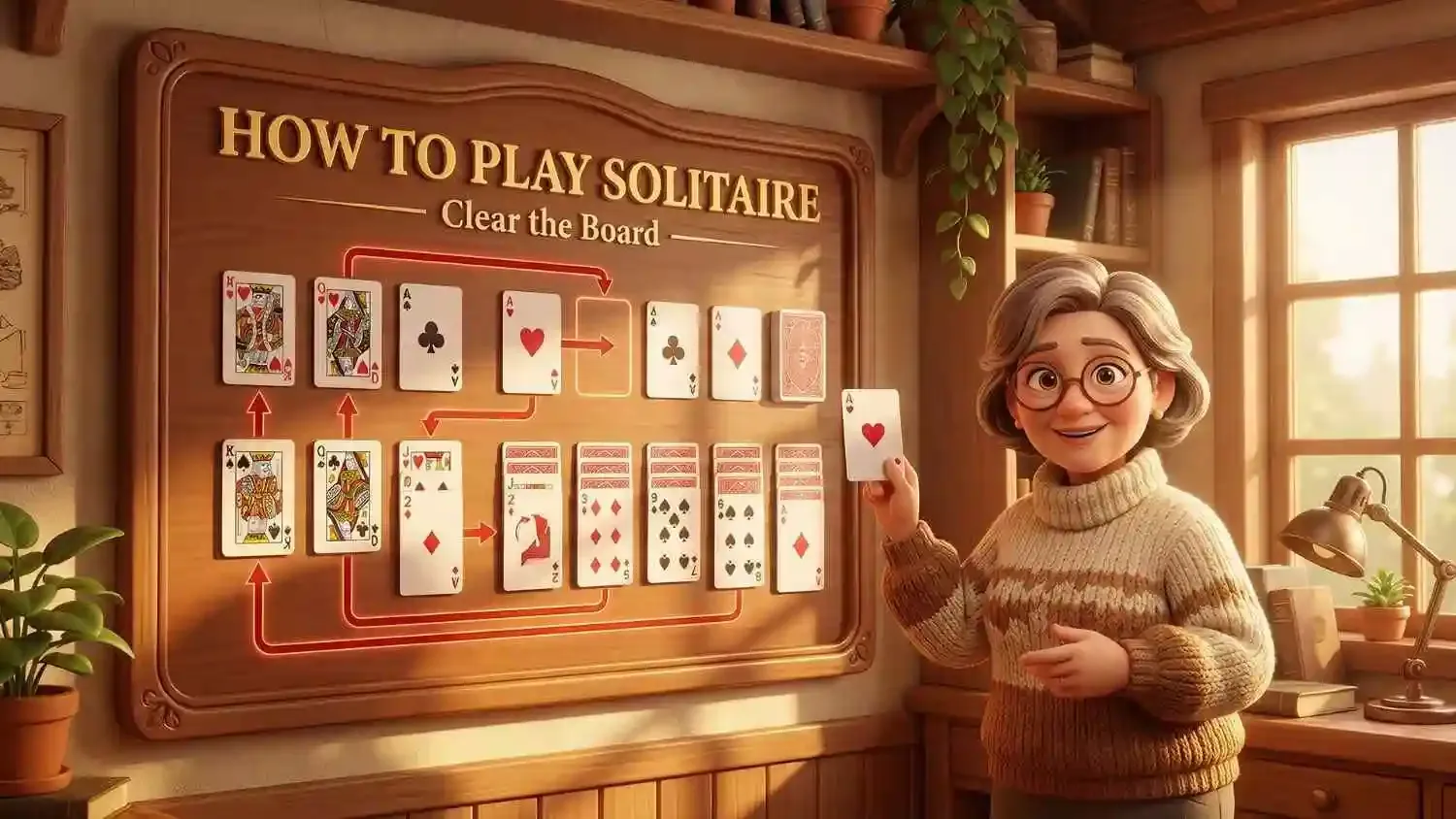
If you are thinking about how to play solitaire or if it is going to be tough to learn solitaire, then the answer is nope its not tough to play solitaire. It looks simple, but once you start playing, you realize there is more thinking involved than you expected.
You are new to solitaire and are wondering how to play it. This guide will step you through all in one step-by-step language in easy language. Whether you choose Play Solitaire Online or use real cards, by the end, you will know the setup, rules, legal moves, and smart beginner tips to play with confidence.
Table of contents
- How Do You Play Solitaire? Step-by-Step Guide
- What Is Solitaire?
- Objective of Solitaire
- What You Need to Play Solitaire
- Solitaire Setup Explained
- How Scoring Works in Solitaire and Other Variations
- The 5 Rules of Solitaire Every Player Must Know
- Legal Moves in Solitaire
- Common Solitaire Variations
- Solitaire Tips and Winning Strategies
- Common Mistakes Beginners Make
- Is Solitaire Always Winnable?
- Conclusion: Start Playing Solitaire With Confidence
How Do You Play Solitaire? Step-by-Step Guide
In case you are still unsure how to play solitaire, take the following steps.
Step 1: Analyze the Initial Layout
Before making any moves, scan the entire table carefully. Check the visible cards in the seven tableau columns and look for the positions of low cards, especially Aces. Identifying potential moves early helps you plan a better strategy. Knowing how many rows in solitaire exist across the tableau, seven in total, gives you a clearer mental map before your first move
Step 2: Reveal Face Down Cards
The primary objective of moving cards within the columns is to uncover the hidden, face-down cards. Each time you flip a hidden card over, you open up new choices, paths, and opportunities to advance the game.
Step 3: Move Cards Between Columns
Drag and shift cards among the tableau columns in accordance with the alternating color and descending sequence rules. When you have the opportunity to shift an entire sequence of cards together, do so to clear space and open up concealed cards underneath.
Step 4: Use the Stock and Waste Piles
Draw from the stockpile only when you have completely exhausted all available moves on the tableau. Always verify if the top card of the waste pile can help you clear a column or reveal a hidden card before drawing again.
Step 5: Build the Foundations
Move cards to the four foundation piles whenever it is safe to do so. While sending Aces and Deuces up immediately is standard practice, be careful not to rush higher cards up too early if they are still needed to support lower cards in the tableau.
Step 6: Complete the Game
Keep cycling through the deck and manipulating the columns until the board is completely cleared. The game is successfully won when all 52 cards are perfectly sorted into their respective foundation piles from Ace to King.
What Is Solitaire?

Solitaire, also known as Patience or Klondike Solitaire, is the world’s most popular single-player card game. Using a standard 52-card deck, the game is played across four main areas: the tableau, the foundations, the stockpile, and the waste pile. Since becoming a household name via Windows 3.0 in 1990, it has remained a favorite way to sharpen focus and pass the time.
Objective of Solitaire
- The main goal of solitaire is to move all 52 cards into the four foundation piles.
- Each foundation pile starts with an Ace and is built up in the same suit in order from Ace to King.
- You win the game when all cards are placed perfectly in the foundation stacks.
What You Need to Play Solitaire
All you require to play solitaire is just a few pieces. You will need a regular deck of 52 cards. Jokers are not used. It is a one-player game, meaning you can play it at any moment on your own.
You can play solitaire using physical cards or play online. Solitaire online is more reasonable because it sets up automatically and is quicker to practice. One of the quickest ways to get started is how to play solitaire on Google, no download, no account, just one search and the board is ready instantly.
Solitaire Setup Explained
The setup of Solitaire is critical because every Solitaire game starts with how the cards are placed on the table.
Tableau Setup With Seven Columns
The tableau is the main playing area. It has seven columns of cards.
- The first column has one card facing up.
- The second column contains two cards with the top card up only.
- This goes on until the seventh column, which has seven cards, and only the top card is open. This is how to win solitaire.
Each column is placed face down, with all the cards that are not at the top of the column.
Foundation Piles Explained
On the foundation piles, you play the finishing winning stacks. Each suit has four foundation piles.
Stock Pile and Waste Pile
The cards left over after the tableau is arranged are placed in the stockpile. These cards are laid face down.
When you draw cards from the stock, they go into the waste pile. The waste pile shows the cards you can currently use from the stock.
Solitaire Setup Diagram Explained

The tableau is placed in the middle of the layout, the stockpile is normally placed at the top left corner, and the foundation piles are at the top right corner. This layout stays the same whether you play with cards or online.
Correct Card Orientation
Face-up cards can be moved and played. Face-down cards cannot be used until they are revealed. Revealing face-down cards is one of the most important goals in solitaire.
How Scoring Works in Solitaire and Other Variations
While playing with a real deck of cards does not involve points, digital versions of the game use a standard solitaire scoring system to track your skill and calculate your performance.
How Points Are Earned
Most online games award points for making smart moves that advance your progress:
- Move Card to Foundation Pile: +10 points (the biggest reward for scoring a goal card)
- Move Card from Waste Pile to Board: +5 points (for successfully bringing a deck card into play)
- Flip a Face-Down Card: +5 points (for uncovering a hidden card on the board)
Bonus Points and Multipliers
To make the game more competitive, digital versions often include extra ways to boost your score:
- Time Bonus: The faster you clear the board, the more bonus points you receive at the end of the game.
- Game Modes: Playing in "Turn 3" mode (drawing three cards at a time) is harder than "Turn 1" mode, so it often gives you a higher score multiplier for your moves.
Note: Every app or website has slightly different scoring rules, but classic physical Solitaire has no points; your only goal is to clear the board and win.
The 5 Rules of Solitaire Every Player Must Know
Understanding the basic solitaire rules makes the game much easier.
1. How to Arrange Tableau Columns: Colors and Sequence
To move cards within the columns, always follow the alternating color rule. You can only place a card on another if it is one rank lower and a different color. For instance, a red 7 must be placed on a black 8.
2. Filling Empty Columns: The King Rule
An empty column on your board is a valuable space. To utilize it, you must place a King—or a sequence of cards starting with a King, into that spot. No other card value is permitted to start a new column.
3. Playing Aces: Starting Your Foundation Piles
Aces are the foundation of your game. As soon as an Ace is uncovered in the tableau or appears at the top of your waste pile, immediately move it to the empty foundation area at the top of your screen to begin building your suit stacks.
4. Building Foundation Piles: Order and Suits
Each of the four foundation piles must be built using cards of the same suit. You must stack them in perfect ascending order: start with the Ace, then add the 2, 3, 4, and continue until you reach the King. Do not mix suits or skip any ranks.
5. Moving Card Sequences: Efficient Strategy
You do not have to move cards one by one. If you have a group of face-up cards already organized in a descending, alternating-color sequence, you can drag and move the entire group at once to a new column, provided the bottom card of your group fits the destination card.
Legal Moves in Solitaire
Knowing legal moves helps avoid mistakes.
Legal Tableau Moves
- Moving a face-up card onto a card of the opposite color and one rank higher.
- Moving a group of correctly ordered cards.
- Placing a King into an empty column.
Legal Foundation Moves
- Moving an Ace to start a foundation pile.
- Adding cards of the same suit in ascending order.
Legal Stock and Waste Moves
- Drawing cards from the stockpile.
- Moving the top waste card to the tableau or foundation if it fits.
- Illegal moves include placing the same color together or breaking suit order in foundations.
Common Solitaire Variations
Klondike Solitaire Classic
This is the standard version most people play.
Draw One vs Draw Three Solitaire
Draw One lets you draw one card from the stock at a time. Draw Three draws three cards, making the game harder.
FreeCell and Spider Solitaire Overview
FreeCell shows all its cards right at the beginning and is more of a skill. Spider Solitaire uses several decks and builds the same sets of suits.
Solitaire Tips and Winning Strategies
1. Clear Hidden Cards in the Longest Columns First
When you have multiple choices to move cards on the board, always prioritize the column containing the most face-down cards. Revealing hidden cards as early as possible gives you more options and helps prevent you from getting stuck later.
2. Move Aces and Twos to Foundations Immediately
Aces and 2s are the foundation starters and cannot support any lower cards on your board. Moving them to the goal spots the exact moment they appear frees up space and helps you kickstart your stacks without blocking your progress.
3. Keep a King Ready Before Clearing a Column
An empty space on your board is incredibly valuable, but it remains useless until you can occupy it. Avoid completely clearing out a column unless you already have a King, or a stack led by a King, waiting to jump into that spot.
4. Build Your Foundation Piles Evenly
Try to advance all four of your goal piles at a similar pace. If you rush one suit too far ahead, you might accidentally trap a card you need later to help move other numbers around on the main board.
5. Prioritize Moving Card Sequences Over Single Cards
Whenever possible, focus on shifting entire blocks of organized cards together rather than moving just one card at a time. This tactic is much more efficient for exposing hidden cards and creating open spaces.
6. Exhaust the Main Board Before Drawing From the Stockpile
Treat your draw deck as a backup plan. Always look for every possible move among your columns first before flipping a card from the stockpile, so you do not accidentally skip over an easy board move and bury a helpful card.
Common Mistakes Beginners Make
- Young amateurs place cards on the foundations too early, thereby preventing useful moves.
- Those columns that are in a void are occupied by inserting the incorrect King.
- Others disregard face-down cards and continue without any strategy for drawing out of stock.
Is Solitaire Always Winnable?
Can you win every game of solitaire? The answer is nope, you can’t win, but most can. Skill plays a big role, especially in Draw One games. Draw: Three versions depend more on luck. Better decisions increase your chances, but the shuffle still matters.
Conclusion: Start Playing Solitaire With Confidence
You are now aware of how to play solitaire, including the setup, rules, legal moves, and winning strategies. Solitaire is a game of patience, planning, and practice. The more you practice, the more you learn about patterns and choices. Play at your own pace, relax, and enjoy the game of getting better with each game.
FAQs
- Play Aces to Kings. Build tableau cards in descending order and alternating color, and build foundation piles using each suit, Ace to King.
- Yes, solitaire is a participant game as a one-player card game that you can play at any time when you feel like being alone. It does not need opposition or collaboration.
- No, not all the solitaire games can be won, as the order of cards being shuffled is important. However, many games can be won with the correct moves, patience, and useful strategy.

How to Play Spider Solitaire With 4 Suits (Rules & Strategy)
Master how to win 4-suit Spider Solitaire with expert strategies, step-by-step tips, and proven moves. Beat the hardest version — start winning today!

8 Mahjong Strategies to Win the Game Every Time
Master mahjong strategy with simple, effective techniques to clear tiles faster, improve focus, and win more games—start playing smarter today!

Pyramid Solitaire Card Setup: Step-by-Step Guide for Beginners
At first glance, you may think Pyramid Solitaire is a relaxing pastime game with simple rules – just match cards that total 13 and clear the pyramid. Well, you’re wrong because if you’ve played the game, you know that winning is not just about luck. It’s about thinking ahead to ensure you don’t get stuck. That means effective use of the stockpile and recognizing the most strategic plays. So, if you’re new to pyramid solitaire or simply looking to improve your skills, this guide explains to you how to control the game and avoid running out of moves.
Mahjong Solitaire Explained: From Relaxing Pastime to Brain-Teasing Challenge
Mahjong Solitaire is an excellent solo-player game. It is enjoyable and relaxing, but also mentally challenging. Using Mahjong tiles, players are to remove all tiles by matching identical pairs.

How to Win Solitaire: Smart Tips to Increase Your Success Rate
Solitaire can be deceptively simple and easy to start, yet challenging to master. In fact, even experienced players find winning consistently quite challenging. Why? Because it takes more than just knowing the rules. It’s also about choosing the right moves at the right time, although that can be difficult to wrap your head around if it’s your first play solitaire online. Thankfully, this guide outlines the strategic insights that will help you improve at solitaire by thinking ahead and making every move count. So, stick around and become a master.


