

Solitaire vs FreeCell: Key Differences & Which Should You Play?

You have probably been in the Stalemate Scenario. You have just one card to a grand victory in Klondike, but there is that last heart, concealed beneath a pile of five cards that you just cannot get up. It seems unjust due to the fact that, in that form of a game, it is.
In FreeCell, however, that scenario almost never happens. While both games fall under the "Patience" umbrella, they offer entirely different mental experiences. One is a game of concealed cards and chance; the other, an entirely transparent logic game in which 99.9 percent of all games are won.
You have to know what the mechanical difference is between the bad shuffle and the smart one, to stop losing to the bad shuffle and to begin to play smarter than that. So you need to play solitaire online or freecell to know the difference.
Table of contents
What is the Difference Between Solitaire and FreeCell?
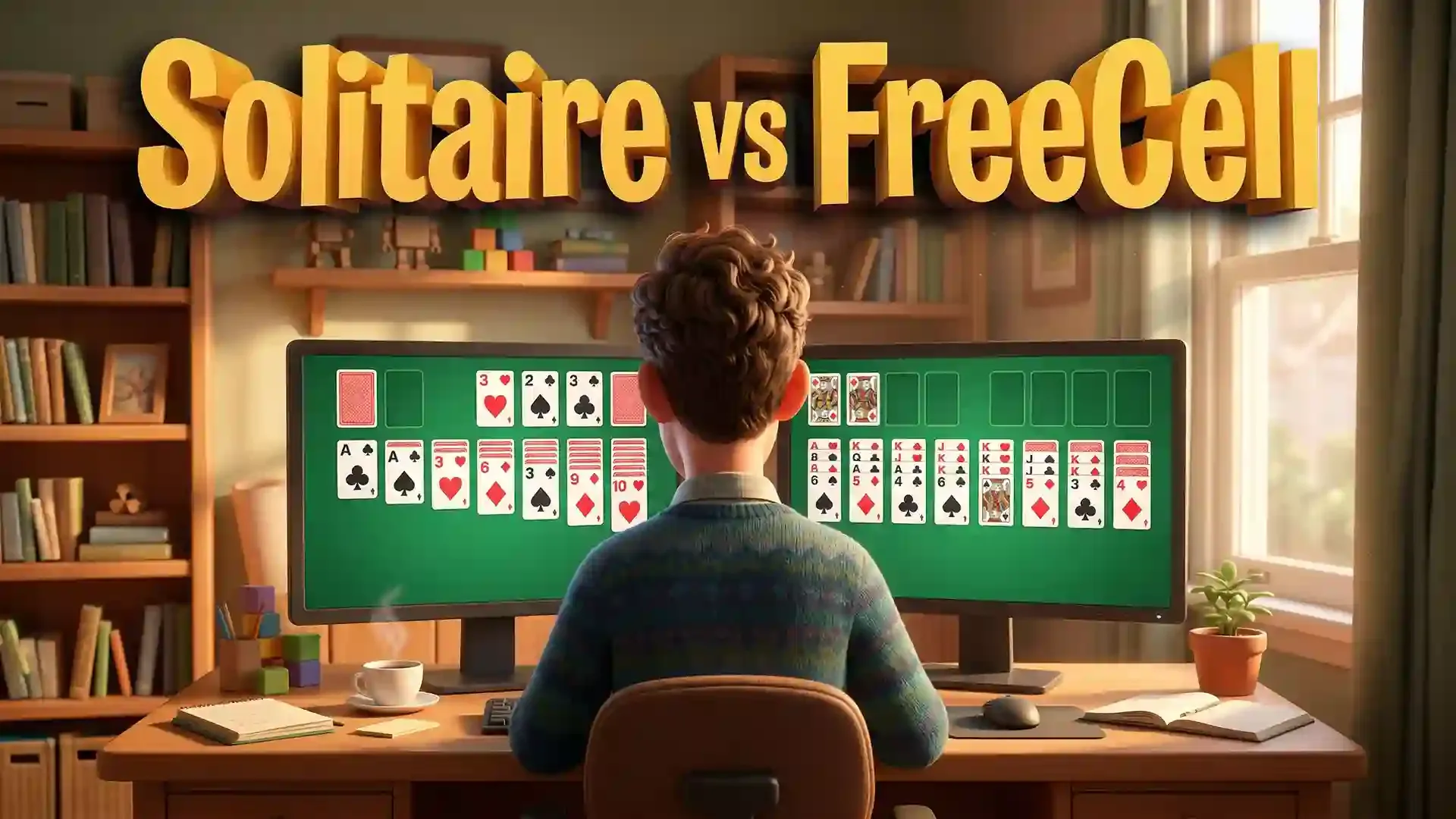
When comparing solitaire vs freecell, the most striking difference is the transition from hidden cards to an entirely open board. In Solitaire, most of the board is a mystery. In FreeCell, the entire board is an open book.
| Feature | Klondike Solitaire | FreeCell |
| Visibility | Partial (Hidden cards) | 100% (All cards face-up) |
| Stockpile/Waste | Yes (Draw 1 or 3) | None |
| Temporary Storage | None | 4 "Free Cells." |
| Solvability | 80% (Theoretical) | 99.99% (Nearly all) |
| Win Rate (Avg) | 10% to 15% | 30% to 45% |
| Empty Columns | Only Kings allowed | Any card/sequence (Standard) |
| Primary Driver | Luck & Discovery | Strategy & Planning |
What Is Klondike Solitaire? (The Classic Experience)
The standard Solitaire that has swept the world through Windows 3.0 is known as Klondike. It plays in the nature of a 7-column setup and the upper card of a pile as seen. The rest are face-down, creating a "discovery" mechanic where you must search through the tableau to find the cards you need. While Klondike solitaire rules are easy to learn, they require a mix of patience and strategy to uncover those hidden stacks and build your foundations.
The Stockpile is a characteristic of Klondike. When you are left with no moves on the board, you take the rest of the deck (typically in Turn 1 or Turn 3 versions). This gives a great element of luck; in the event that the card you require is at the very bottom of the stack of cards, you may lose the game no matter how good you play.
What Is FreeCell? (The Strategist's Choice)
FreeCell Game is the thinking person's alternative. It uses an 8-column layout, and here is the kicker: every single card is dealt face-up. There are no hidden surprises and no stockpile to draw from.
To compensate for the lack of a draw pile, FreeCell gives you four "Free Cells" temporary holding spots at the top left. These cells are your tactical breathing room. They allow you to move a card out of the way to reach a buried Ace or King. Because you can see every card from move one, FreeCell is less about "hope" and more about "calculation."
Deep Dive: Key Differences Explained
Card Visibility: Hidden vs. Fully Revealed
Klondike relies on the dopamine hit of the "reveal." There is a rush when you flip over a face-down card and find exactly what you need. FreeCell replaces that rush with the satisfaction of a long-term plan coming together. Because you can see the entire board, you have to think several moves ahead, much like a game of Chess.
Stockpile vs. Free Cells: Managing Resources
In Klondike, your success depends on the order of the draw pile. If you play "Turn 3," the game becomes a complex puzzle of cycling through the deck. In FreeCell, your success depends on how well you manage your four empty cells. Every time you fill a free cell, you reduce your ability to move large stacks of cards.
The "Supermove" Logic: How Mobility Works
One of the most technical differences involves how many cards you can move at once. In FreeCell, your mobility is governed by a specific formula: Your move limit equals (Empty Free Cells + 1) doubled for every Empty Column you have. There are some moves to see how to win solitaire.
This means if your free cells are full, you might only be able to move one card at a time. If they are empty, you can move entire blocks of cards. Understanding this "Supermove" logic is the hallmark of a pro player.
Luck vs. Skill: The 99.9% Solvability Rule
As many people ask, is solitaire luck or skill? The answer is that, mathematically, almost every FreeCell game is winnable. Out of the original 32,000 Windows deals, only one, Deal #11982, was famously proven to be impossible for a human to solve. Contrast this with Klondike, where a "bad shuffle" can result in a game that is 100% unwinnable from the start.
Which Is Harder: Solitaire or FreeCell?

The answer depends on your goal.
- Klondike is harder to win. Because of the hidden cards, you are fighting the deck as much as your own brain. The average win rate is around 10% to 15%. However, you can also learn solitaire strategies to win the game.
- FreeCell is harder to play well. It has a much higher "skill floor." A beginner can accidentally win a game of Klondike, but a beginner in FreeCell will likely "block" themselves within five moves by filling their free cells too quickly.
Which Game Should You Play?
Choose Klondike Solitaire if you:
- Want a quick, low-pressure experience for a 5-minute break.
- Enjoy the "reveal" of hidden cards.
- Are you looking for a casual way to "zone out"
Choose FreeCell if you:
- Prefer logic puzzles like Sudoku or Chess.
- Hate losing to luck or a "bad shuffle."
- Want a game that rewards deep concentration and planning.
Spider Solitaire vs FreeCell: The Next Level
Whenever FreeCell becomes easy, it is time to play Spider Solitaire. Whereas in FreeCell there is a single deck of cards and 8 columns, in Spider there are two decks of cards and 10 columns. It is the last to be shown in the solitaire world with no free cells. It requires massive tableau management and is significantly more difficult than both Klondike and FreeCell.
Tips to Win at Both Games
Klondike Pro Tips:
- Expose Large Piles First: Always prioritize flipping cards in the columns with the most hidden cards.
- Don't Empty a Column Without a King: An empty space is useless unless you have a King ready to fill it.
- Move Aces Early: Get your Aces to the foundations as soon as they appear.
FreeCell Pro Tips:
- Keep Cells Empty: Treat your four free cells like an emergency fund. They should be used when no other option is available.
- Create an Empty Column: An empty tableau column is more powerful than a free cell because it allows you to move entire sequences.
- Scan for Aces: Since all cards are face-up, find where the Aces are buried and make a plan to dig them out first.
Conclusion
It is not about which game is better, Solitaire or FreeCell; it is about which game will suit your mood. Klondike is the final casual time-waster, and its combination of skill and luck keeps it unpredictable. Beyond just passing the time, the mental benefits of playing solitaire include improved memory and sharper problem-solving skills.
FAQs
- No, solitaire is a type of game (also referred to as Patience). The classic version is Klondike, and a particular variant of strategy, using an open board, is FreeCell.
- Approximately, 99.99 percent of deals can be solved. In comparison with Klondike, it is almost impossible to lose in FreeCell due to a bad deal, and it is because of the player.
- It is called the four cells on the upper left part of the game board, which are used as temporary storage for single cards.
- Klondike Solitaire is simpler to play since the rules are not complicated to learn. FreeCell, however, is superior for beginners who wish to learn strategy but do not want to be frustrated by hidden cards.
- Spider Solitaire is much harder. It involves two decks and requires you to build same-suit sequences to clear them, whereas FreeCell only requires alternating colors.

Benefits of Solitaire: Boost Your Mind and Focus Today
Discover the benefits of Solitaire for brain health, focus, memory, and stress relief. Learn how this classic card game sharpens thinking and boosts mental clarity.

Is Every Solitaire Game Winnable? Discover the Truth Today
Uncover the history of Solitaire and trace its evolution from early card traditions to the iconic game enjoyed by millions today.
13 Types of Solitaire Games: The Ultimate Guide (With Rules, Variations & Tips)
Explore the different types of Solitaire games including Klondike, Spider, FreeCell, Pyramid, and more. Compare rules and find the version you enjoy most.

Word Hurdle Solitaire Game: Rules Explained
Word Hurdle Solitaire is an exciting card-based game that tests your word-building skills. This guide covers the complete rules, differences from other games, scoring system, and tips for beginners.
Spider Solitaire Rules: How to Play, Set Up & Win (Complete Guide)
How to play Spider Solitaire made easy—learn the rules, card setup, and proven strategies to improve your skills. Play smarter and win more games now!


