


Klondike Solitaire Tips: 13 Winning Strategies to Improve Your Game

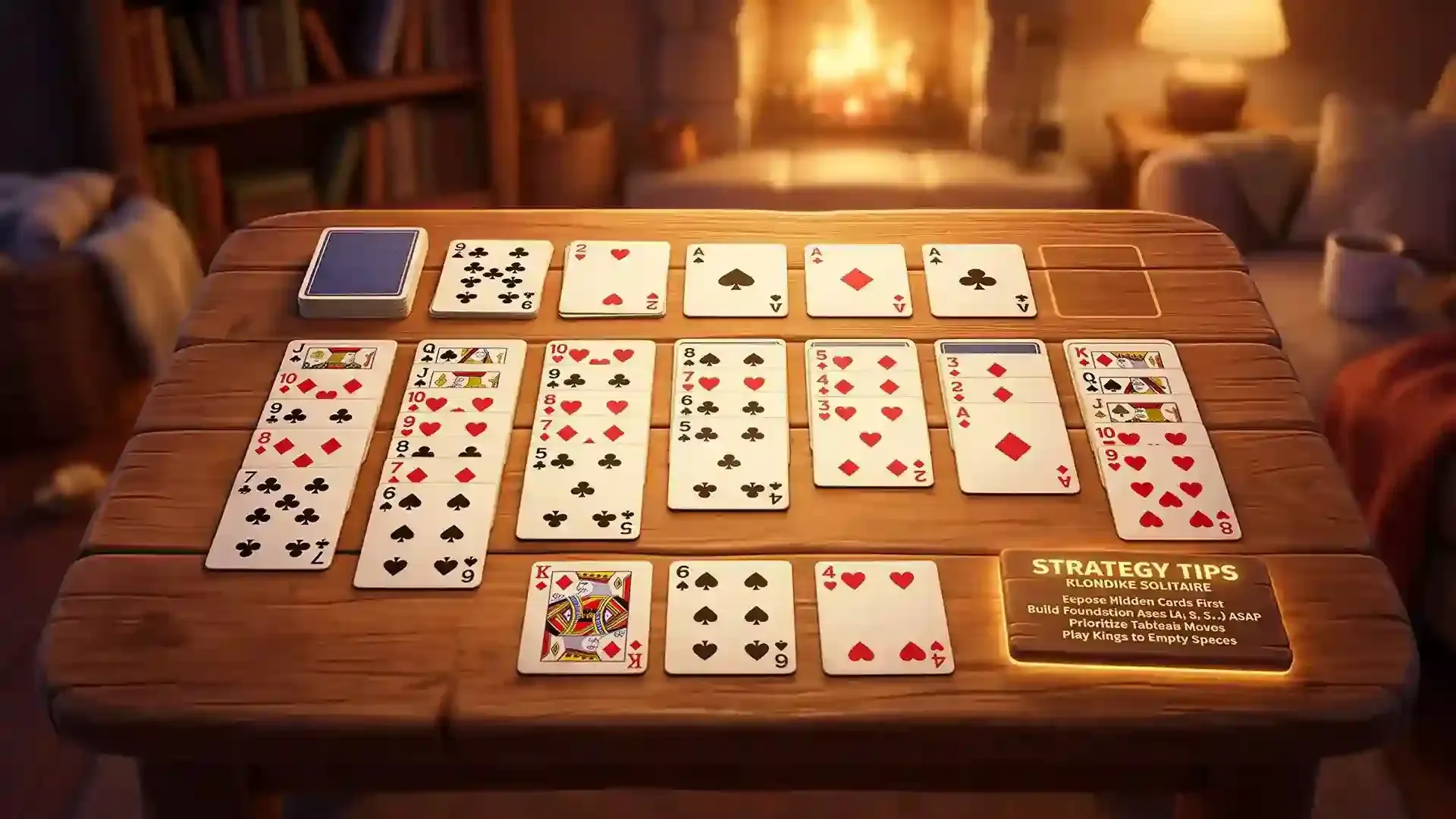
Klondike Solitaire is one of the oldest and simplest variations of solitaire. However, if you are struggling to win the game, you should check out 13 winning strategies to improve your game.
You can play solitaire online, and if you keep playing daily, you'll improve at it. You'll also understand it way better through our tips.
Table of contents
Why Strategy Matters in Klondike Solitaire
Many people misunderstand Klondike Solitaire. Some think you can win every game, while others believe it is only about luck. The truth is that about 80% of games could be won if you knew where every card was. Since you cannot see the face-down cards, your win rate depends on your choices.
A good plan focuses on the long term. A move that looks helpful now might block you later. The best way to win is to keep your options open for as long as possible. You can play Klondike solitaire to practice thinking ahead and making better moves.
Quick Refresher: How Klondike Works
Before getting into the deep strategy, it is important to be sure of the basics.
Objective of the Game
The idea is to transfer all 52 cards to the four foundation piles, in order of suit (Hearts, Diamonds, Spades, Clubs), from Ace to King.
Tableau, Foundations, and Stock Explained
- Tableau: The seven columns that make up the main play area.
- Foundations: The four empty slots at the top where you build your suits.
- Stock: The remaining cards in your hand are used to draw new options.
How Moves Are Made
Cards in the tableau must be placed in descending order and in alternating colors. For example, a Red 6 can only be placed on a Black 7. Do learn how to set up Solitaire game in the Klondike variation.
13 Klondike Solitaire Tips to Win More Games
1. Always Reveal Hidden Cards First
If you have a choice between moving a card from the stock or moving a card within the tableau to reveal a face-down card, always choose the tableau. Uncovering hidden cards is the only way to gain more information and open up new move possibilities.
2. Don’t Rush Cards to the Foundation
It is tempting to zip every Ace and Deuce to the top immediately. However, those low cards are often needed as "anchors" on the tableau to hold other sequences. If you move them too early, you might end up with a 3 of a different color with nowhere to put it. While many players focus on the fastest solitaire game strategy, rushing these moves can actually make you lose.
3. Create Empty Columns Only When You Have a Plan
An empty column is only useful if you have a King ready to occupy it. If you empty a column without a King, you have actually reduced your "workspace" from seven columns to six. Only clear a spot if it helps you flip a hidden card.
4. Move Kings Strategically
Don't just move any King into an empty slot. Check your tableau. If you have a Red Queen waiting for a home, prioritize moving a Black King. If you have a Black Queen, find a Red King. Moving the wrong color King can stall your progress for the rest of the game.
5. Think Two or Three Moves Ahead
Before committing to a move, ask yourself: "What happens next?" If I move this 8 onto that 9, does it free up a card I actually need, or am I just moving pieces for the sake of moving them?
6. Use the Stock Pile Carefully
There is a mode called Draw-3 where the sequence of the stock varies with the number of cards that you draw. Occasionally, one is better off discarding a playable card on the initial through the deck so that it remains in a favourable position to be discarded again. This is especially true in Klondike Solitaire Turn 3, where cards cycle through the deck less predictably and every pass counts more than in the single-draw version.
7. Compare All Possible Moves Before Acting
Often, you will have two different 7s that can be moved onto the same 8. Look at the piles beneath them. Which pile is larger? Which one has more face-down cards? Always move the card that reveals the most hidden information.
8. Keep Long Alternating Sequences Intact
Solitaire strategies is try to keep your sequences as long as possible on the tableau. This makes it easier to move large "chunks" of cards around when a new King or higher card becomes available.
9. Avoid Blocking Low Cards
Be careful not to build a massive stack of high cards if you have several low cards buried underneath. This is a common way to get stuck. If you see a 2 or 3 buried deep, prioritize moves that dig toward them.
10. Don’t Clear a Column Too Early
If you clear a column in the first two minutes of the game, you are playing a risky game. Unless that move revealed a large number of cards, you might find that the empty space sits uselessly for the next ten minutes.
11. Balance Tableau and Foundation Progress
Try to keep your four foundation piles at roughly the same level. If your Spades are at 10 but your Hearts are at 2, you will likely need those high Spades back on the tableau to help move other cards.
12. Use the Undo Button to Explore Better Moves
In digital play, the undo button is a learning tool. If you hit a dead end, go back and try the "other" move you were considering. This helps you understand the "branching logic" of Solitaire.
13. Practice Pattern Recognition
Over time, you will start to see "danger zones," specific layouts of cards that usually lead to a loss. Recognizing these early allows you to take bigger risks to break the pattern before it becomes a deadlock, especially when you feel Stuck in Solitaire and need better strategies to recover.
Common Mistakes That Reduce Your Win Rate
Many players lose because they play on "autopilot." The biggest mistake is moving cards automatically. Just because a move is legal doesn't mean it is good. Another pitfall is overusing the stock.
When you only play the stockpile and not the tableau, you will never find the hidden cards that you need to win. Lastly, playing too quickly will cause you to miss out on back-moves scenarios where you can use a card on the foundation to get back to the board to open a new line.
Advanced Klondike Solitaire Strategy Tips
To the middle players, the game is one of risk management.
- When to Take Risks: When you are presented with an option of making a safe move or making a move that can expose a card of the largest pile, you should take the risk on the large pile.
- Difficult Layouts: If your Aces are buried at the bottom of the piles, you must play aggressively and use the stockpile as your primary source of moves until those Aces are freed.
- Unwinnable Games: If you're asking is every solitaire game winnable, the answer is no. Learn to recognize when a game is dead. If the cards that you have to move are covered by the other cards (for example, you have to move a Red 7 to a Black 6, but the Red 7 is covered by the Black 6), the game is over.
How to Improve Your Win Rate Over Time
To understand how to win at solitaire, you need to have a strategy to play instead of moving cards to keep yourself busy. It is always best to seek and turn over the concealed cards beforehand in order to have a variety of choices. In case you lose a game, have a quick glance back to check whether you have moved an Ace too early or missed a better move.
Keep your table open to your Kings. It also serves to keep your stacks of best at the same level, so that one suit does not get too far ahead of the others. Easy and hard mode switching will make you acquire new tricks and keep your mind active. The fastest way to improve is by playing every day — pick the best free solitaire app for iPhone or Android and make it part of your daily routine.
FAQs
- In the best approach, priority should be given to discovering face-down cards in the biggest tableau piles. This maximises your information and gives you the most move options.
- No, depending on the rules (Draw-1 vs. Draw-3), only about 80% of games are winnable with perfect play. In practice, most players win between 30 and 50 percent of their games.
- You are likely moving cards to the foundation too quickly or clearing columns without having a King ready to fill the space. Focus on the tableau organization first.
- No. Only empty a column if you have a King ready to move into it. An empty column with no King is a wasted space that limits your move options.
- Yes. Draw-1 is much easier and allows for more aggressive play. Draw-3 requires more careful planning and memorization of the stockpile order.

Benefits of Solitaire: Boost Your Mind and Focus Today
Discover the benefits of Solitaire for brain health, focus, memory, and stress relief. Learn how this classic card game sharpens thinking and boosts mental clarity.

Is Every Solitaire Game Winnable? Discover the Truth Today
Uncover the history of Solitaire and trace its evolution from early card traditions to the iconic game enjoyed by millions today.
13 Types of Solitaire Games: The Ultimate Guide (With Rules, Variations & Tips)
Explore the different types of Solitaire games including Klondike, Spider, FreeCell, Pyramid, and more. Compare rules and find the version you enjoy most.

Word Hurdle Solitaire Game: Rules Explained
Word Hurdle Solitaire is an exciting card-based game that tests your word-building skills. This guide covers the complete rules, differences from other games, scoring system, and tips for beginners.
Spider Solitaire Rules: How to Play, Set Up & Win (Complete Guide)
How to play Spider Solitaire made easy—learn the rules, card setup, and proven strategies to improve your skills. Play smarter and win more games now!


