


Solitaire Scoring Explained: How Is Solitaire Scored & What Is a Good Score?

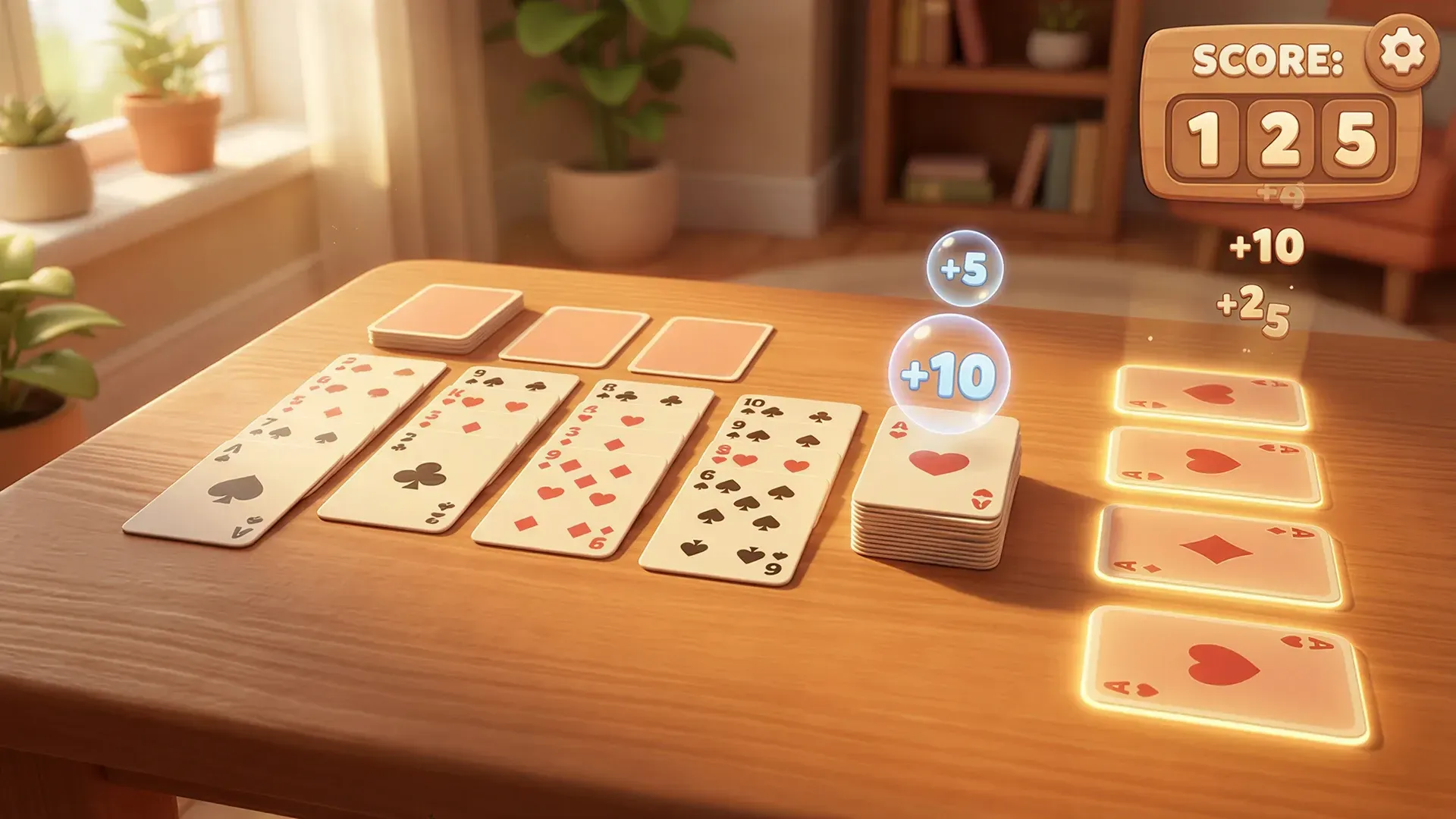
In the case concerning the knowledge of how to score solitaire, we have all felt that sense of relief when the cards are jumbled together in a trance-like fashion to bring a well-earned win.
This makes you feel like a professional until you look at the end of the screen and realize that the number you have earned doesn't reflect your work; it could be 4,500 or only 600. What is the reason that the last number is so dissimilar to the win condition?
Scoring is one of the most confusing parts of the game, especially when you play Solitaire online. Most of us are taught how to clear the board and construct foundation piles long before we realize that a sophisticated mathematical calculator is running in the background.
Table of contents
How Is Solitaire Scored?
When you have ever searched for how to score solitaire and found that you were confused about what others said, it is not your loss. This can be explained by the fact that Solitaire lacks a single, universal governing body of rules.
Scoring is not commonly practiced in the physical world; the only thing one wants to do is to win. Developers in the digital world, however, require methods for ranking players. This has given rise to the scoring dialects.
The most well-known is Classic Windows Scoring (Standard), which was popularized by Microsoft in the 90s. It rewards individual actions and punishes time. Then there is Vegas Solitaire Scoring, where you bet, order the deck, and attempt to win the money back. Lastly, Modern App/Web Scoring programs such as Solitaire Bliss or Solitaired usually manipulate the traditional rules, occasionally using moves and time as the only criteria for leaderboard purposes.
Moves, cards moving to the foundation, time, and your use of undo are the most important factors that will always influence your score, no matter what platform you are using. Controlling your score begins with understanding the interaction among these four variables.
How Does Solitaire Scoring Work?
To understand how solitaire scoring works, you have to look at the game as a ledger. You start with zero (or a deficit in Vegas mode), and every action you take is a transaction. These solitaire techniques help explain how the game constantly tallies positive actions against negative penalties in real time.
Basic Scoring Actions
In the Standard scoring system, the game incentivizes you to progress on the board. Moving a card to the Foundation is the most valuable move, typically earning you +10 points. This is why your score skyrockets at the end of a game when the cards auto-complete.
Turning over face-down cards is a crucial, often overlooked scoring opportunity that nets you +5 points. It rewards you for digging through the pile rather than just cycling the stock. Additionally, moving a card from the stock to the tableau usually awards +5 points. While there isn't a specific "bonus" for finishing a suit, the cumulative points of moving Ace through King to the foundation create the bulk of your final total.
Time-Based Scoring
Time is the silent score-killer. In timed modes, the game deducts points based on the clock. A common formula is a penalty of -2 points for every 10 seconds of play. This might seem negligible, but in a tricky 5-minute game, that’s a sizable chunk of points gone simply for thinking.
Some modern versions operate on an untimed basis, which is great for casual play but usually doesn't qualify for competitive leaderboards. Conversely, some versions offer a "Time Bonus" at the end, a massive point calculation like 700,000 divided by total seconds, which is why speedrunners achieve scores that seem mathematically impossible.
Move Penalties
Efficiency is key because the game does not want you to click without purpose, and this is often where players misunderstand how to win Solitaire in competitive modes. In strict Standard scoring, you are penalized for going through the stockpile too many times. Often, after three passes, you lose 20 points every time you reset the deck.
The "Undo" button is the biggest trap for digital players. We love it, but it comes at a cost. Depending on the app, hitting undo can dock you anywhere from 2 to 5 points. If you use undo to peek at hidden cards and then go back, you are effectively paying points for information.
Klondike Solitaire Scoring Explained
Klondike solitaire scoring applies to the classic version most players know, with the familiar triangular tableau defined by traditional Klondike Solitaire rules. In Standard Klondike, the theoretical maximum total is often cited at around 24,113, achievable only with perfect play and a large time bonus.
A popular variant is Vegas Klondike, where points are treated like money. You start by buying the deck for minus fifty-two and earn five for each card moved to the foundation. Moving eleven cards breaks even, while twelve or more puts you in profit. Time penalties are usually removed, but stock passes are limited.
What Is a Good Score in Solitaire?
This is the most common question for new players: What is a good score in solitaire? Because scoring ceilings change based on time bonuses, raw numbers can be misleading. However, assuming a Standard scoring system without massive time bonuses, here are the benchmarks.
Beginner Score Range (300–600): If you are just learning how to score solitaire, landing here is a solid start. It usually means you won the game, but likely took your time or used the undo button frequently.
Average Player Score (600–900): A "Good" score sits here. To hit this, you are winning consistently and doing so quickly. You aren't abusing the undo button, and you are prioritizing revealing face-down cards.
Advanced / Expert Score (900+): Anything over 900 is excellent. To breach 1,000+, you essentially need to play a "perfect" game with minimal stock usage, zero undos, and rapid foundation building.
How to Score Solitaire Better
When you find yourself at the amateur level, you may need less speed of fingers to master the art of scoring solitaire; you may need more skill in making decisions. The simplest way to increase the score is to stop neglecting the face-down cards.
You get +5 points every time you turn a face-down card in the tableau. Columns with the most concealed cards should be given priority. Suppose you are given two options: one card hidden in a column of 1 card, and the other with 5 cards. Then you would always take the 5. This unlocks depth and points.
Also, manage the stock carefully. Don't mindlessly click through the pile. Try to play every possible card from the stock immediately rather than saving it for later.
How to Get More Points in Solitaire
For those who are already winning and want to push higher on the leaderboards across different solitaire variations, you need to exploit the mechanics rather than rely on safe play alone.
One trick is the "Foundation Drop." Moving a card from stock to tableau is +5, and then from tableau to foundation is +10. That’s 15 points total. If you move it straight from stock to foundation, you only get 10. Experienced players will momentarily land cards on the tableau just to squeeze out those extra 5 points.
Also, utilize "Auto-Complete." Once the game is solved, do not manually drag the cards. The computer moves them instantly, stopping the clock and maximizing your time bonus. Finally, avoid the "King Trap." Filling empty columns with a King too early can stall your game if you don't have the cards to build on it, leading to time penalties.
Common Solitaire Scoring Mistakes to Avoid
Even seasoned players make simple errors that bleed points. If you want to retain your #1 spot, especially when switching between browser Solitaire vs app Solitaire, avoiding these traps is critical.
- Moving to Foundation Too Early: You see an Ace and a Two and send them up. But if you needed that Two to hold a Three in the tableau, you'll have to pull it back down, which often costs you a -15 point penalty.
- Excessive Redeals: Each full cycle of the deck often incurs a penalty. If you catch yourself cycling the deck three times without making a move, you are hemorrhaging points.
- Overusing Undo: Treat the Undo button like a nuclear option. Losing 5 points per undo adds up fast. Ten undos is -50 points, the equivalent of moving 5 cards to the foundation.
Solitaire scoring adds a layer of depth to a game that many dismiss as simple luck. Whether you are battling the clock in a timed Klondike match or counting your pennies in Vegas mode, understanding the math behind the moves changes how you play.
To master it, focus on efficiency first. Minimize your reliance on the undo button, prioritize flipping those face-down cards, and treat every move as an investment. Ready to beat your personal best? Play Klondike Solitaire and test your scoring skills today.
FAQ
- No, it varies significantly. While Standard Windows-style scoring is common, many sites use custom systems focusing on fewest moves or pure time.Does time affect solitaire score? Yes, in almost all Standard modes. You typically lose points every 10 seconds. Finishing quickly also triggers a large Time Bonus.
- In Standard scoring, the maximum without time bonuses is around 5,200. With time bonuses, scores can reach over 24,000 depending on the software.
- Yes. For example, Spider Solitaire often starts you with 500 points and subtracts 1 for every move, only awarding 100 points when a full suit is assembled.

Benefits of Solitaire: Boost Your Mind and Focus Today
Discover the benefits of Solitaire for brain health, focus, memory, and stress relief. Learn how this classic card game sharpens thinking and boosts mental clarity.

Is Every Solitaire Game Winnable? Discover the Truth Today
Uncover the history of Solitaire and trace its evolution from early card traditions to the iconic game enjoyed by millions today.
13 Types of Solitaire Games: The Ultimate Guide (With Rules, Variations & Tips)
Explore the different types of Solitaire games including Klondike, Spider, FreeCell, Pyramid, and more. Compare rules and find the version you enjoy most.

Word Hurdle Solitaire Game: Rules Explained
Word Hurdle Solitaire is an exciting card-based game that tests your word-building skills. This guide covers the complete rules, differences from other games, scoring system, and tips for beginners.
Spider Solitaire Rules: How to Play, Set Up & Win (Complete Guide)
How to play Spider Solitaire made easy—learn the rules, card setup, and proven strategies to improve your skills. Play smarter and win more games now!


